

Lots of ink is being spilled in regards to the results AI is having on studying and training.
The drawbacks are apparent. For a lot of classroom assignments, AI is now adequate that it will probably merely do your homework for you. However having AI do your homework is self-defeating. You possibly can’t be taught with out doing the work.
That stated, the alternatives AI might present are quite a few. Alongside its drawbacks, AI additionally brings the chance for reasonable and affected person tutoring, on-demand explanations, further apply issues and help in analysis.
To paraphrase Dickens, in the case of studying, it truly is each the most effective of instances and the worst of instances.
This brings me to a latest essay written by the at all times insightful Carl Hendrick. In it, he evaluations latest findings on AI’s affect on studying, drawing an analogy between the introduction of autopilot and the degrading of pilot talent:
The factor I discover actually fascinating about this story and why I believe it has a lot import for studying and AI is that his core analysis was that the autopilot was in actual fact, not the issue. The reality is that automated perform in planes saves much more lives than it endangers and I believe the identical will probably be true of self-driving vehicles. (I’ve no real interest in the hackneyed declare that the machines are dangerous and the people good. The machines are, on the entire, magnificent I believe). The factor I believe is so attention-grabbing is that when confronted with an emergency, the pilots reached instinctively for extra automation not much less, when the suitable factor to do was typically to drop down a stage and fly. So the hazard just isn’t automation itself however over-dependency on automation and that is fairly clearly what occurs once we give novice learners unfettered entry to chatbots.
Hendrick doesn’t blame the scholars for this alarming development; he blames instructional establishments themselves. Colleges have been vacillating between desirous to undertake a pro-AI stance, encouraging college students to make use of AI of their work supplied they correctly “cite” the outcomes, and embracing the language of educational honesty in a useless try to keep up the established order.
Clearly, that is untenable. Training should change due to AI.
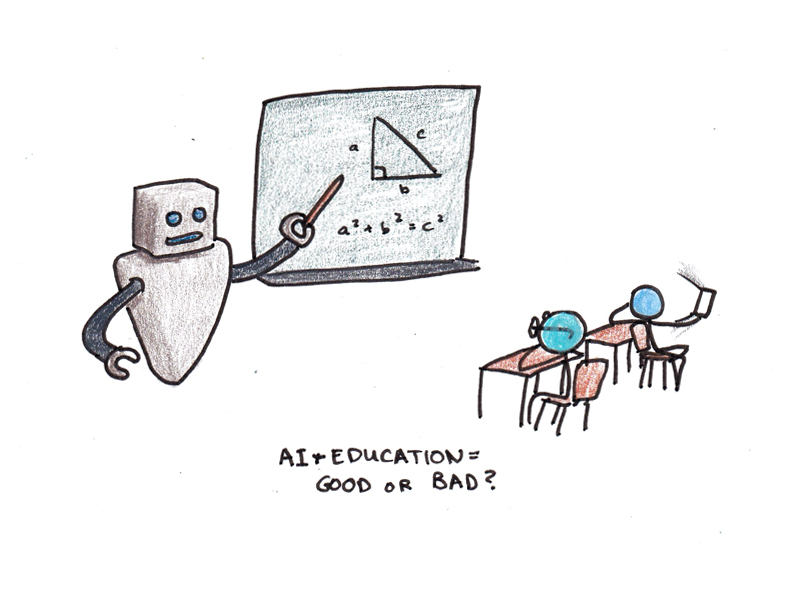
The reply isn’t to undertake some imprecise AI-forward resolution which merely accepts AI output as a professional substitute for college students doing the work themselves. As an alternative, it is going to be understanding that AI, like calculators and Wikipedia, could be each an unbelievable software and a debilitating crutch.
What’s the Proper “Quantity” of AI Use for Optimum Studying?
It’s fairly clear that the answer of getting AI do your homework for you’ll to not lead to a lot precise studying. Enamored as I’m by the probabilities unlocked by the arrival of coding brokers, it’s apparent to me that vibe coding actively impairs your means to be taught to jot down code by hand.
Whether or not this trade-off is legitimate within the realm of productive work is a tougher query. I think the reply of whether or not vibe-coding enhances or undermines productiveness relies upon rather a lot on the stage of information acquisition. Inexperienced persons who haven’t constructed up a psychological mannequin of what code is being written are shedding out on the chance to apply foundational abilities. Consultants, who can steer the method, might find yourself benefitting from the saved effort.
However no person can deny that in case your aim was to be taught to jot down code by hand, getting Claude to do your give you the results you want will lead to much less studying.
What’s extra attention-grabbing to me is that if there’s an optimum quantity of or timing for AI assist. Which means, even when an excessive amount of AI is clearly dangerous, would possibly studying be hindered if there may be too little?
Should you had requested me this query within the lead as much as my 2019 ebook, Ultralearning, I might have stated no. I used to be a robust advocate for doing onerous downside fixing and the related psychological effort it requires as a option to be taught tough abilities.
Nevertheless, after the analysis that led to my 2024 ebook, Get Higher at Something, I’m now not satisfied. Practising issues is actually an important a part of studying any talent. However the cognitive load concerned can simply turn out to be too excessive. Getting assist, whether or not it’s within the type of a labored instance, a completion downside or only a trace to get you unstuck, could be sooner for studying than floundering.
Some Tentative Tips
In training analysis, conversations about totally different pedagogical approaches typically span many years. On that timescale, AI has solely been right here for the blink of an eye fixed. Subsequently, I anticipate it’ll take a while earlier than a mature consensus on AI best-practice emerges within the analysis literature.
Nevertheless, I’d prefer to share my greatest guess of what a few of these AI tips would possibly appear to be, absent stronger evidence-based work:
1. You possibly can’t be taught from work you don’t do your self.
That is apparent, nevertheless it must be restated. Whereas AI-assistance might assist or hurt studying, it’s clear that something you get a chatbot to do in toto isn’t going to mean you can be taught the underlying talent.
2. Don’t use AI in your first try.
For a lot of duties, there is just one downside. In such circumstances, I believe it’s nearly at all times higher to try an answer by yourself earlier than wanting up the reply. This appears notably true in artistic domains the place every downside is exclusive. Asking an AI for assist with the beginning of an essay, as an illustration, will invariably form what path you find yourself following, robbing you of the essential expertise of constructing your individual judgement round a subject and choosing your individual path to analysis and argue.
3. Don’t use AI in your final try.
What for those who can’t remedy the issue regardless of your greatest efforts? Assuming this can be a repeated downside, the analysis is pretty clear that seeing a labored instance or clarification or getting instruction goes to be higher than persevering with to battle. Thus, switching to getting assist with AI after a failure appears prudent. However, for those who’re going to learn from studying, you have to then try one other downside of the identical sort with out AI assist.
4. Do use AI to counsel various concepts and sources.
Whereas beginning with AI is prone to trigger you to skip over the mandatory onerous considering that leads to studying, I do suppose AI could be helpful in suggesting alternate options you may need missed. Right here, the superhuman breadth of information possessed by AI could be an unlimited asset—surfacing strategies, papers, books and concepts you will have missed in your first move.
5. Do use AI to repair confusion and errors.
Equally, after you’ve accomplished your first try at fixing an issue, I might sometimes encourage wanting on the knowledgeable resolution for suggestions. AI can’t solely generate expert-level options in lots of domains, however it will probably assist level out the supply of confusion and errors.
See-Do-Suggestions (+AI)

In Get Higher at Something, I argued that a lot of efficient studying seems to be like a apply loop: Seeing entails getting instruction, viewing a labored instance or in any other case getting data into your head to information the seek for the suitable reply. Doing entails working towards by yourself. Suggestions entails getting some related sign from the setting about how efficient your apply was.
AI has the potential to help with each the primary and final aspect of that loop. What it can’t substitute is the center step—doing the work for your self.

